

Series vs Parallel Solar Panels: Which Connection Is Better for Your Solar System?
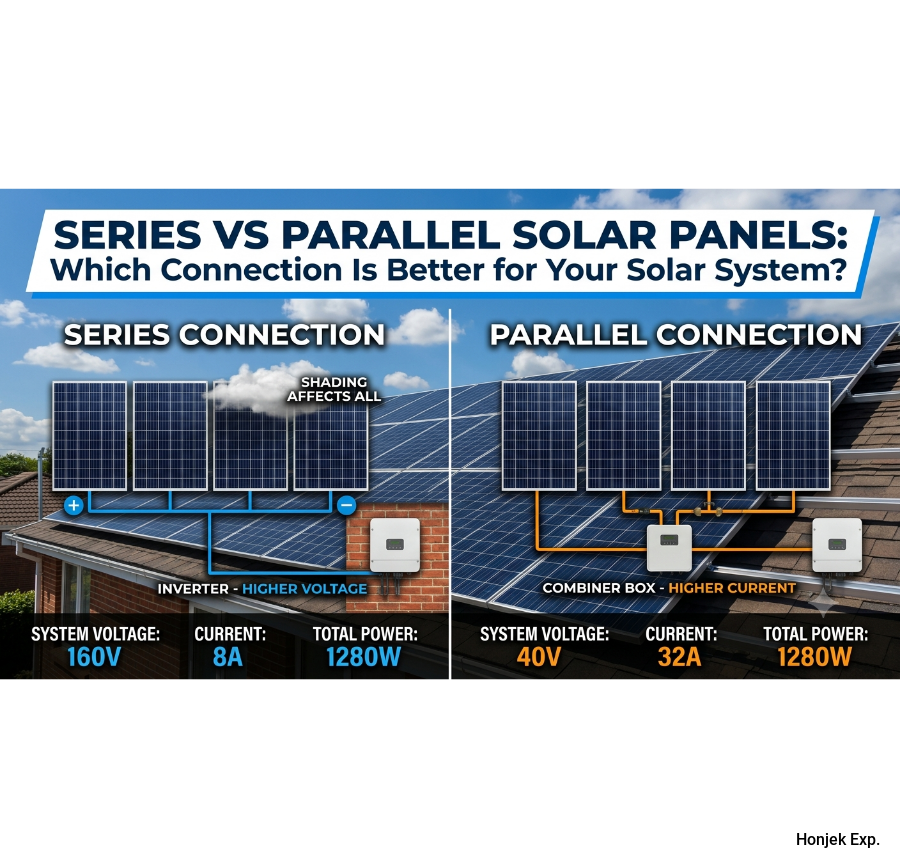
Series vs Parallel Solar Panels: Which Connection Is Better for Your Solar System?
By Honjek Technical Limited | HonjekExpress Marketplace
Introduction
When designing a solar power system, one of the most important decisions is how the solar panels should be electrically connected: in series, in parallel, or in a series-parallel combination.
The connection method directly affects the PV voltage, current, inverter MPPT performance, cable sizing, protection requirements and overall system efficiency.
Understanding the difference between solar panels in series vs parallel is therefore essential for homeowners, businesses, technicians, installers and anyone planning to purchase a solar power system.
In this guide, Honjek Technical Limited explains how series and parallel solar panel connections work, their advantages and disadvantages, and how to select the appropriate configuration for a solar inverter.
What Does Connecting Solar Panels in Series Mean?
When solar panels are connected in series, the positive terminal of one panel is connected to the negative terminal of the next panel.
The voltage of the panels adds together, while the current remains approximately the same as the current of one panel.
Series connection formula
Total Vmp = Vmp × Number of panels
Total Voc = Voc × Number of panels
Current ≈ Current of one panel
Example
Assume a 550 W solar panel has:
- Vmp = 41.5 V
- Voc = 49.5 V
- Imp = 13.25 A
If four panels are connected in series:
Vmp = 41.5 × 4 = 166 V
Voc = 49.5 × 4 = 198 V
Current ≈ 13.25 A
Total power:
550 W × 4 = 2,200 W
Therefore, a 4-panel series string produces approximately:
166 Vmp × 13.25 A ≈ 2,200 W
What Does Connecting Solar Panels in Parallel Mean?
When solar panels are connected in parallel, all positive terminals are connected together and all negative terminals are connected together.
In this configuration, the voltage remains approximately the same as one panel, while the current increases.
Parallel connection formula
Total Vmp ≈ Vmp of one panel
Total Voc ≈ Voc of one panel
Total Imp = Imp × Number of parallel strings
Example
Using the same 550 W panel:
- Vmp = 41.5 V
- Voc = 49.5 V
- Imp = 13.25 A
Two panels in parallel provide approximately:
Vmp = 41.5 V
Voc = 49.5 V
Imp = 13.25 × 2 = 26.5 A
Total power:
550 × 2 = 1,100 W
Series vs Parallel: The Main Difference
Characteristic| Series| Parallel
Voltage| Increases| Remains approximately the same
Current| Remains approximately the same| Increases
PV power| Increases| Increases
MPPT voltage| Higher| Lower
Cable current| Lower for same power| Higher
Cable losses| Can be lower| Can be higher
Typical application| Reaching inverter MPPT voltage| Increasing array current
Main concern| Maximum PV voltage| Maximum PV current
The most important principle is:
«Series increases voltage; parallel increases current.»
Why Solar Installers Often Use Series Connections
Modern solar inverters typically require a relatively high DC input voltage for efficient MPPT operation.
For example, an inverter might specify:
- MPPT operating range: 120–450 V
- Maximum PV voltage: 500 V
A single 550 W panel producing approximately 41.5 V at maximum power would clearly be insufficient to operate effectively within such an MPPT range.
Connecting several panels in series increases the PV voltage.
For example:
6 × 41.5 V = 249 V
This places the string comfortably within the nominal MPPT range.
However, the designer must also check the temperature-adjusted Voc to ensure the string does not exceed the inverter's maximum PV voltage.
Why Parallel Connections Are Used
Parallel connections become useful when additional PV power is required without increasing the operating voltage beyond the inverter's limits.
For example, suppose one string contains:
6 panels × 550 W = 3.3 kW
If two identical strings are connected in parallel:
6S2P = 6.6 kW
The approximate electrical characteristics become:
- String Vmp ≈ 249 V
- Array current ≈ twice the current of one string
- Total PV power ≈ 6.6 kW
This type of configuration is common in larger residential and commercial PV systems.
What Does 6S2P Mean?
Solar installers often use notation such as 6S2P.
It means:
6S = six panels in series
2P = two series strings connected in parallel
Therefore:
6 × 2 = 12 panels total
Using 550 W panels:
12 × 550 W = 6,600 W
So the array is approximately 6.6 kWp.
The voltage is determined primarily by the six-panel series string, while the current is approximately doubled by the two parallel strings.
Series-Parallel Solar Panel Configuration
Large solar installations commonly use a combination of series and parallel connections.
For example:
8S3P
means:
- 8 panels in each series string
- 3 identical strings in parallel
- 24 panels total
With 550 W panels:
24 × 550 W = 13,200 W
or:
13.2 kWp
The exact configuration must be checked against the inverter's:
- MPPT voltage range
- Maximum PV voltage
- Maximum PV input current
- Maximum PV short-circuit current
- Maximum PV power
- Number of MPPT trackers
Series vs Parallel: Which Is More Efficient?
Neither connection is automatically "more efficient."
The correct configuration depends on the solar inverter and site design.
However, increasing PV voltage can reduce the current required to transmit a given amount of power.
Because conductor losses are related to current:
Power loss = I²R
where:
- I = current
- R = cable resistance
Higher current produces disproportionately higher resistive losses.
Therefore, a properly designed higher-voltage PV string can help reduce DC cable losses and conductor requirements.
But this does not mean you should simply connect as many panels in series as possible. The inverter's maximum PV voltage is an absolute design constraint.
Important: Temperature Changes Solar Panel Voltage
One of the most commonly overlooked aspects of PV string design is temperature.
Solar panel voltage generally:
Increases when temperature decreases
and
Decreases when temperature increases.
This means you must check both extremes.
At high module temperature
Vmp decreases.
Therefore, the designer must ensure that:
Hot-condition Vmp remains within the inverter's MPPT operating range.
At low module temperature
Voc increases.
Therefore:
Cold-condition Voc must remain below the inverter's maximum PV voltage.
This is particularly important when connecting many panels in series.
Example: Checking a 6-Panel String
Assume each panel has:
- Vmp = 41.5 V
- Voc = 49.5 V
Six panels in series:
Vmp = 6 × 41.5 = 249 V
Voc = 6 × 49.5 = 297 V
At STC, this appears straightforward.
However, if the inverter's maximum PV voltage is 300 V, the configuration is already extremely close to the limit before temperature correction.
A cold-weather Voc calculation could push the actual string voltage above 300 V.
Therefore, STC Voc should never be treated as the final maximum string voltage.
Effects of Partial Shading
Series and parallel configurations also behave differently under shading.
In a series string, the current through the string is constrained by the weakest-performing module or section of the string, depending on the module and bypass-diode behaviour.
Partial shading can therefore reduce the output of a series string.
Modern solar modules use bypass diodes to reduce the impact of partial shading, while MPPT technology helps optimize operation.
Nevertheless, good system design should consider:
- Roof orientation
- Shadows from buildings
- Trees
- Water tanks
- Antennas
- Adjacent structures
- Different roof pitches
Where different sections of a roof have significantly different orientations or shading conditions, separate MPPT inputs can be advantageous.
Can Different Solar Panels Be Connected Together?
Generally, solar panels connected in the same string should have compatible electrical characteristics.
Avoid mixing modules with significantly different:
- Vmp
- Voc
- Imp
- Isc
- Power ratings
unless the system has been specifically engineered to accommodate them.
For parallel strings connected to the same MPPT, matching panels and string configurations are strongly preferred.
Series vs Parallel for Different Solar Systems
Small residential solar systems
Series connections are commonly used to achieve the voltage required by the inverter's MPPT.
Large residential systems
A series-parallel arrangement may be appropriate to achieve the required voltage and PV capacity.
Commercial solar systems
Multiple series strings and parallel string configurations are commonly used, with careful MPPT allocation, protection and monitoring.
MPPT charge controllers
The panel configuration must be selected according to the controller's maximum PV voltage and current specifications.
How to Choose the Correct Solar Panel Configuration
Before deciding between series and parallel, obtain the solar panel datasheet and inverter datasheet.
Check:
Solar panel
- Maximum power — Pmax
- Vmp
- Voc
- Imp
- Isc
- Temperature coefficients
Inverter/MPPT
- Minimum MPPT voltage
- Maximum MPPT voltage
- Maximum PV voltage
- Maximum PV current
- Maximum PV short-circuit current
- Maximum PV power
- Number of MPPT trackers
Then calculate:
Series Vmp
Series Voc
Parallel current
Total PV power
and finally perform the temperature correction.
Common Mistakes to Avoid
Mistake 1: Choosing panels based only on wattage
A 550 W panel does not tell you whether its voltage and current are suitable for your inverter.
Mistake 2: Ignoring maximum PV voltage
Too many panels in series can produce a dangerous DC over-voltage condition.
Mistake 3: Ignoring maximum PV current
Too many parallel strings can exceed the inverter's PV input current.
Mistake 4: Ignoring temperature
Cold conditions can increase Voc significantly.
Mistake 5: Assuming a 48 V battery requires a 48 V PV array
The PV input voltage and battery voltage are different design parameters in many inverter systems.
Mistake 6: Mixing mismatched panels
Different panel characteristics can cause unequal current or voltage behaviour.
Practical Example: 12 × 550 W Solar Panels
Suppose you have:
12 × 550 W = 6.6 kWp
There are several possible configurations.
Option A — 12S1P
12 panels in series.
Approximate Vmp:
12 × 41.5 = 498 V
This may be unsuitable for an inverter with a 500 V maximum PV voltage because cold-condition Voc could exceed the limit.
Option B — 6S2P
Six panels in series and two strings in parallel.
Approximate Vmp:
6 × 41.5 = 249 V
The current is approximately doubled compared with one string.
Option C — 4S3P
Four panels in series and three strings in parallel.
Approximate Vmp:
4 × 41.5 = 166 V
The array current is approximately three times the current of one string.
Which configuration is correct?
It depends on the inverter's MPPT voltage and current limits.
There is no universal "best" configuration without checking the actual equipment specifications.
Series vs Parallel: Quick Decision Guide
Choose series when you need to:
- Increase PV voltage
- Reach the inverter's MPPT voltage
- Reduce current for a given PV power
- Reduce DC cable losses where appropriate
Choose parallel when you need to:
- Increase PV current
- Increase total PV power while maintaining string voltage
- Add additional compatible PV strings within the inverter's current limits
Choose series-parallel when you need to achieve both:
- The required operating voltage
- The required PV power/current
Frequently Asked Questions
Is it better to connect solar panels in series or parallel?
Neither is universally better. The correct configuration depends on the inverter's MPPT voltage range, maximum PV voltage, maximum current and PV power rating.
Does series increase solar panel wattage?
The total power increases because additional panels are added, but the main electrical effect of a series connection is an increase in voltage.
Does parallel increase solar panel voltage?
No. In a correctly matched parallel configuration, voltage remains approximately the same while current increases.
Can I connect 550 W panels in series?
Yes, provided the resulting Vmp and temperature-corrected Voc remain within the inverter or MPPT controller's specifications.
Can I connect different wattage solar panels in parallel?
It may be technically possible in some circumstances, but it is generally preferable to use matching panels with compatible electrical characteristics.
What happens if solar panel voltage is too high?
Exceeding the inverter's maximum PV voltage can damage equipment or cause protective shutdown. The maximum PV voltage must never be exceeded.
What happens if PV voltage is too low?
The inverter may fail to start, operate outside its optimum MPPT range or harvest less available solar energy.
Does series connection increase cable losses?
For the same power, a higher-voltage series configuration generally carries lower current, which can reduce resistive losses. However, the actual cable loss depends on conductor size, length, current and system design.
Conclusion
Understanding series vs parallel solar panels is fundamental to proper PV system design.
Remember the simple rule:
«Series = higher voltage.»
«Parallel = higher current.»
For larger systems:
«Series + parallel = higher voltage and higher total current/power.»
But the final configuration must never be selected from panel wattage alone.
A professional solar design should verify Vmp, Voc, Isc, Imp, temperature coefficients, MPPT voltage range, maximum PV voltage, maximum PV current, maximum PV power and the number of MPPT trackers.
At Honjek Technical Limited, we use these parameters when designing and installing solar PV systems for residential, commercial and industrial applications.
For solar panels, hybrid inverters, lithium batteries, solar generators, protection equipment, cables and other electrical products, explore the HonjekExpress Marketplace.
About Honjek Technical Limited
Honjek Technical Limited provides technical engineering solutions including:
- Solar PV design and installation
- Solar inverter and lithium battery systems
- Electrical installation and maintenance
- CCTV installation and maintenance
- Engineering procurement
- Solar system troubleshooting and maintenance
HonjekExpress Marketplace supplies solar, electrical, technical and selected consumer products.
- MPPT Voltage Calculation
- How to Calculate Solar Panel Requirements
- How to Size a Solar Inverter
- How to Choose a Lithium Battery
- Solar Cable Sizing
- Solar DC Breaker Sizing
- Complete Solar System Installation Guide
- Solar Inverter Buying Guide in Nigeria
Recent Posts

Honjek Technical Limited: Professional Solar Installation Company in Rivers State
Professional Solar Installation Company in Nigeria: What to Look For Before Choosing an Installer
Solar Maintenance: How to Keep Your Solar System Efficient, Reliable, and Long-Lasting
450W vs 550W vs 620W Solar Panels: Which Is Best for Your Solar System?
Solar Panel Wiring: Complete Guide to Solar PV Connections, Cable Sizing and Protection
Powering Innovation, Delivering Value.
Shop smart with Honjek Express Marketplace — your one-stop destination for quality electrical, solar, CCTV, and everyday products at competitive prices. Trusted service, verified products, and fast delivery you can rely on.

About Honjek Express
Welcome to Honjek Express — a fast-growing Nigerian online marketplace built to connect customers with quality technical products, engineering solutions, and reliable procurement services. Operated by HONJEK TECHNICAL LIMITED, Honjek Express combines technology, engineering expertise, and digital commerce to simplify access to solar energy products, electrical materials, CCTV security systems, industrial tools, technical books, and modern engineering solutions.
At Honjek Express, we focus on delivering trusted products, professional support, and value-driven services for individuals, businesses, contractors, institutions, and industries across Nigeria and beyond. Our platform is designed to bridge the gap between quality engineering products and customers seeking reliable, affordable, and durable solutions.
With years of practical experience in electrical installation, solar power systems, CCTV surveillance, industrial maintenance, and procurement services, our team understands the technical demands of modern projects. This enables us to recommend suitable products and solutions that meet real operational needs.
Our Core Services
Solar system products and accessories
Inverters, lithium batteries, and solar panels
CCTV cameras and security surveillance systems
Electrical installation materials and industrial components
Engineering procurement services
Technical books and educational materials
Professional technical consultation and support
Why Choose Honjek Express?
Quality and verified products
Technical engineering expertise
Competitive pricing
Reliable customer support
Fast response and delivery process
Commitment to innovation and customer satisfaction
Our mission is to promote modern engineering awareness, improve access to clean energy and security technology, and support businesses and homes with dependable technical solutions.
At Honjek Express, we do not just sell products — we provide practical engineering solutions that power businesses, secure properties, and improve lives.
Visit Honjek Express to explore our products and services.